Working with Demons
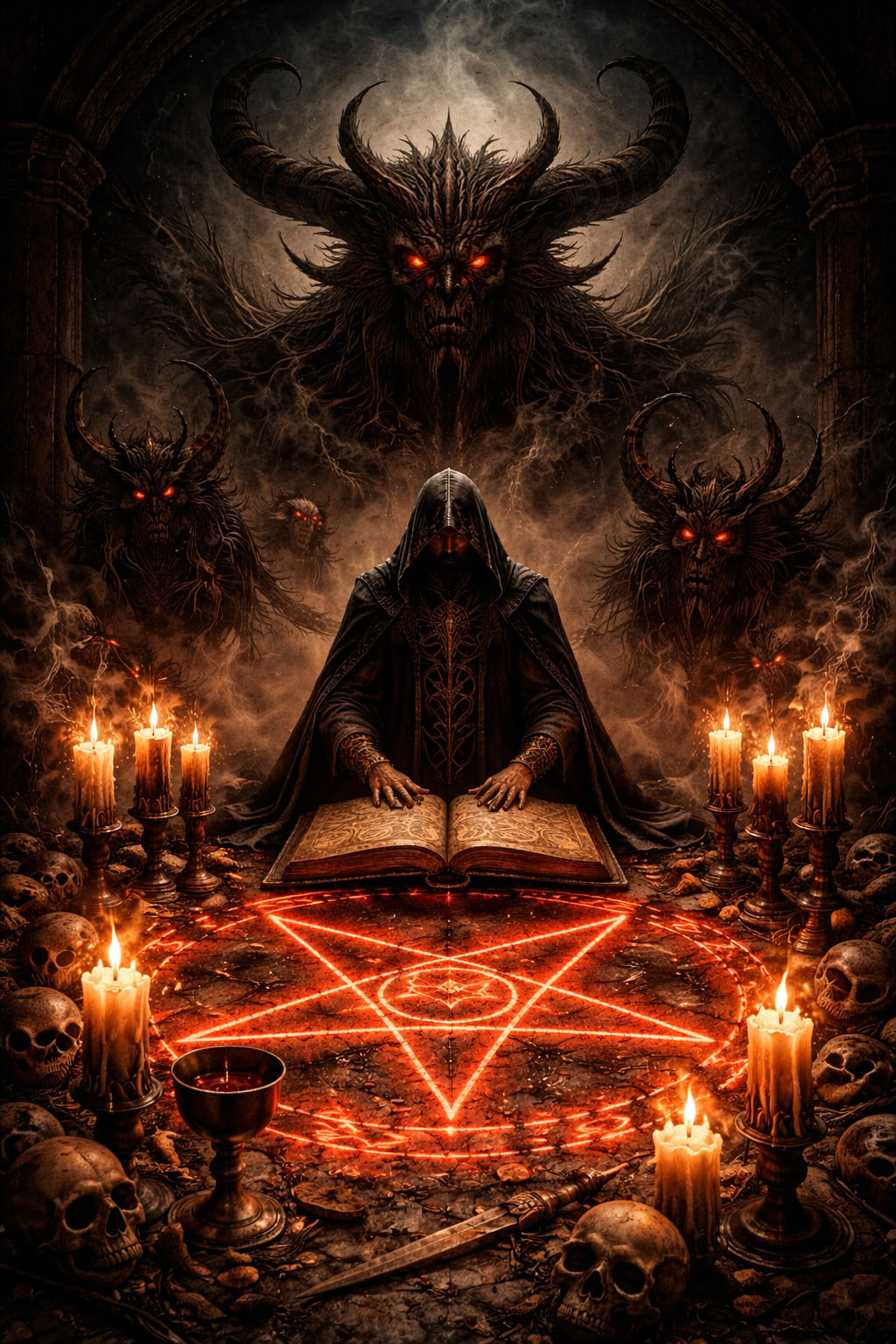
In the magical modernity we currently stand in, more and more people feel the desire—or at least the curiosity—to understand the nature of those spirits commonly referred to as demons. Some approach them in search of power, others out of necessity, others out of fascination, and many because they sense that there is a form of spiritual intelligence there that does not fit within traditional devotional frameworks. The motivations are as varied as the practitioners themselves.
We are also living in a cultural moment in which darkness, the forbidden, and what was once expelled from the temple are being actively reclaimed. Figures that were labeled as “evil” by institutional religions are now reinterpreted as ancient forces distorted by theological propaganda. And this is where we need to be honest: there is some truth in this, and there is also a great deal of romanticism. The line between the two is thin. Often, what is presented as “historical recovery” is actually a modern emotional need desperately seeking roots. And let’s be clear—something being modern does not make it false or invalid. But it does demand honesty.
If we want to work with demons seriously, the first step is obvious but often avoided: understanding where the concept of the demon comes from, how it was constructed, who wrote about it, with what intentions, and how folklore, theology, politics, social fear, and literature became entangled. Not in order to return to moralistic or Manichean thinking, but to gain a complete map before stepping onto the path.
Starting from a non-dogmatic position means accepting something uncomfortable for many: there is no single way to understand demons, no universal method of approaching them, and no shared, objective “nature” that everyone experiences in the same way. One practitioner may encounter a spirit and describe it as an initiator—severe but fair—while another may experience the same entity as invasive, confusing, or deeply unsettling. This does not necessarily mean one of them is lying. The spiritual world is profoundly subjective, and contact never occurs in a vacuum. It happens through the psyche, perception, symbolic language, personal context, magical model, life circumstances, and actual level of training.
The framework matters. A ceremonial magic approach—with its circles, constraints, licenses, and banishings—is fundamentally different from a modern, devotional, or relational approach. And not everything modern falls under the Left-Hand Path. There are contemporary traditions that engage these spirits through psychological, animistic, goetic, Luciferian, demonolatrous, or hybrid models. Each creates a different dynamic and a different kind of relationship.
If we stop for a moment and look honestly, one thing becomes obvious: most people’s ideas about demons do not come from religious history—they come from horror movies. Hollywood has done more demonological “catechism” than most theological schools. For decades, demons have been portrayed as monstrous entities that slam doors, throw objects, possess people as gateways into the physical world, and whose ultimate goal is to steal “your immortal soul,” as if it were some kind of metaphysical collectible.
I enjoy horror films immensely. But I am fully aware that they are fiction. They exploit fear, ignorance, collective suggestion, and fascination with the unknown. From them, you can extract aesthetics and entertainment—but not an operational manual. My first recommendation, then, is simple: separate fiction from real spiritual work. Not because fiction is useless, but because it does not describe how spiritual relationships actually function. Mixing the two only builds a mental cage.
Before diving headfirst into calling every demon listed in medieval grimoires, there is a step most people skip because it offers no instant gratification: asking yourself what you are actually doing. What are your goals? Why do you want to work with these beings? What do you mean when you say “demon”? Are you seeking knowledge, concrete results, inner transformation, contact with the numinous, or simply the need to feel chosen or special? These questions may sound obvious, but they are not.
We live in an era obsessed with instant gratification, even in spirituality. It is painful to watch people jump from spirit to spirit like trading cards—today one “speaks” to them, tomorrow another “claims” them, next week another “crowns” them—until they burn out, become paranoid, or start fabricating signs to sustain an internal narrative. If you want to do this seriously, you must ask those uncomfortable questions first. They are the first act of adult magic.
Once that foundation is clear, the next step is deciding what kind of demons you want to work with. And yes, this requires study. As with any spirit, there is exchange. This is not about calling randomly. It is about approaching the entity that aligns with your purpose and temperament. That means reading, comparing sources, understanding historical context, studying descriptions and functions, and engaging with grimoires critically—without swallowing them whole as dogma or dismissing them as fantasy.
Another crucial question follows: what kind of relationship do you want? Something short-term and transactional—clear request, offering, agreement, closure—or a long-term relationship involving devotion, altars, or sustained interaction. Neither is inherently superior. The former has strong historical precedent in folk magic, ceremonial traditions, and pact-based narratives. The latter, however, is largely a modern phenomenon in its widespread form.
This is where another myth must be dismantled. Many stories about medieval “diabolists” or demon worshippers belong more to inquisitorial propaganda and folklore than to reliable historical records. In contrast, modern developments—demonolatry, Luciferianism, theistic Satanisms, and related Left-Hand Path currents—are clearly documented from the late twentieth century onward. There is nothing wrong with this being modern. What is problematic is pretending that there has been an uninterrupted lineage “since ancient times” when no solid evidence supports that claim. Inspiration from folklore and grimoires is valid; self-deception is not required for legitimacy.
Taking all of this into account, we can finally speak about nature.
This is my perspective, based on direct experience: I do not believe demons are agents of evil seeking human suffering. I do not believe they are embodiments of chaos in a childish sense. But I also do not believe they are misunderstood beings of light who want humanity to evolve out of cosmic compassion. That is simply another caricature.
Demons, like many other spirits, do not belong to our everyday reality. They exist in different spiritual realms, accessed through specific techniques: trance, dream-work, evocation, projection, scrying, oracles, sigils, names, images, thresholds. And most importantly: they have their own agendas. Their own interests. They are not on call 24/7 for personal whims. Sometimes they respond. Sometimes they do not. Sometimes they test you. Sometimes they ignore you. This, too, is part of the work.
“Demon” is also a broad category. The entities listed in medieval goetic grimoires are one thing; analogous spirits in other cultures are another; liminal beings thrown into the same category for convenience are yet another. This is why study matters—to avoid confusing categories and mistaking every dark presence for the same thing.
As for form, they may appear masculine, feminine, androgynous, or beyond gender entirely. Many are shapeshifters. Their appearance may depend on intention, method of contact, symbolic language, or the perceptual capacity of the practitioner. Some appear pestilent, distorted, terrifying. Others appear beautiful, seductive, even friendly. And here caution is necessary: friendliness can be strategy—or it can simply be their nature.
In general, I consider demons amoral. They do not operate according to human moral frameworks. Moral labels are usually human projections shaped by religious fear rather than genuine spiritual essence. This does not mean they are benevolent. It means they are not playing our game. And yes, the risks are real—not cinematic, but psychological and spiritual: obsession, dependency, perceptual distortion, ego inflation, dissociation, paranoia, exhaustion, and destabilizing spiritual experiences. This is why a solid foundation in magical practice and a coherent tradition matter.
Methods of contact are many. Ceremonial evocation seeks a form of physical manifestation, but this should be understood correctly. It is rarely literal materialization. It is a dense, almost tangible presence within the ritual space. This depends heavily on the operator’s perceptual abilities. In more modern or flexible systems, one may use oracles, dream incubation, spiritual projection, symbol-based meditation, automatic writing, scrying, trance states, and so-called “channeling”—the latter requiring discipline, as it is fertile ground for self-deception.
Risk management begins with something unglamorous but essential: do not obsess. Progressive, grounded work is far more powerful than a single dramatic ritual fueled by suggestion. Maintain critical judgment regarding what you receive. Not everything that comes “from the other side” is absolute truth. Experiences must be tested against reality and integrated consciously. If something is meaningful, it will prove so over time.
Here is a practical rule worth remembering: if a supposed demon demands incoherent actions, extreme sacrifices, self-harm, illegal behavior, or destructive life choices, stop immediately. That is not initiation—it is confusion. It may be an opportunistic spirit, psychological contamination, projection, or a mix of factors. Whatever it is, stopping is intelligence, not weakness. Serious work transforms—it does not destroy.
At the same time, promises matter. Do not make meaningless vows under ritual emotion. Spirits tend to take words literally. The goal is not domination or servitude, but alliance, teaching, or structured exchange. Offerings can be simple—candles, incense—or more personal: tobacco, alcohol, food, creative acts such as poetry, painting, music, or the construction of a dedicated altar. What matters is coherence and sincerity.
Proper demon work begins with one spirit, not many. Start simply: study the sigil, learn the name, repeat it like a mantra, light a candle, burn incense, invite respectfully, state intention clearly. Observe dreams, emotional shifts, subtle changes, patterns—without turning every coincidence into a sign. This process unfolds over weeks or months. If you are unwilling to commit, do not begin. There are no serious results overnight.
Once contact is established, deeper work becomes possible: clearer communication, specific agreements, or targeted assistance. Always with record-keeping, discernment, and boundaries.
Regarding banishings: I do not favor automatic expulsion rituals. These belong to specific ceremonial paradigms popularized by the Hermetic Order of the Golden Dawn and later by Crowley. Banishment banishes—it is often an act of disrespect when applied reflexively. However, energetic hygiene is another matter. Cleansing, grounding, closing the ritual space—these are acts of self-care, not hostility. Perspective matters.
Choosing the appropriate demon for your goal is essential. If you seek knowledge, work with initiatory or teaching spirits. If you seek magnetism, desire, or charisma, choose accordingly. Study descriptions: temperament, planetary correspondences, days, metals, colors, herbs, animals, symbols. These are not rigid laws, but symbolic languages that structure contact and ritual coherence.
My final recommendation is simple: approach this work with an open mind, understanding that demons are one category among many spirits. Move step by step. Respect without fear. Fear distorts perception and creates bad experiences. Question what you receive—but do so with logic and respect. And above all, do what every serious practitioner must do: work, record, learn, adjust, and continue.
Daemon Barzai